
Where Medical Function Meets Legal Proof
Long-term disability issues show up in specific types of cases. A construction worker with a spinal injury who cannot return to physical labor. A nurse with a shoulder injury who cannot safely lift patients. A driver with chronic pain who cannot sit for extended periods. In each of these cases, the dispute is not whether an injury occurred. It is whether the person can still do their job, or any job, on a sustained basis.
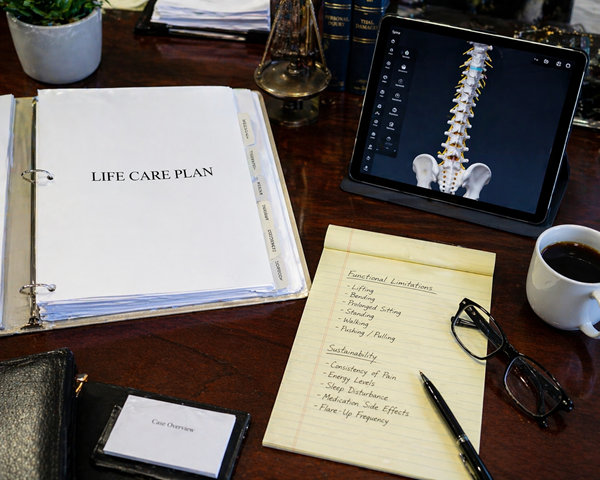
Medical records alone usually do not answer that. An MRI might show a disc herniation. Treatment notes might document pain. But neither explains whether the person can stand for 8 hours, consistently lift, or maintain pace over a full workweek. That is the gap the defense targets when they argue the person can return to work or is exaggerating limitations.
A rehabilitation specialist, working as a medical expert consultant, steps into that gap. They evaluate what the person can actually sustain over time and translate that into work restrictions, functional limits, and long-term care needs. In a serious personal injury or workers’ compensation case, that analysis is what supports claims for lost earning capacity and future medical care. Without it, the case often relies too heavily on subjective complaints.
The Foundation of Earning Capacity Claims
Physical medicine and rehabilitation (PM&R) experts are often brought into cases where the gap between the medical record and the claimed disability is likely to be challenged. The defense will argue that the client can return to work, that the complaints are out of proportion, or that recovery should have already occurred. Without a structured functional analysis, those arguments can gain traction.
A well-prepared rehabilitation evaluation closes that gap by tying limitations directly to observable, testable factors. It reframes the case around what can actually be sustained over time, not what can be done once in a clinical setting.
In practice, attorneys rely on rehabilitation specialists to establish:
- Work Capacity: What the client can realistically perform over a full workday and whether any employment is sustainable.
- Functional Tolerance: Limits on sitting, standing, lifting, and repetitive activity that affect real job performance.
- Consistency of Symptoms: Whether reported pain and limitation align with the injury and expected progression.
- Daily Living Impact: How the injury affects independence, including mobility, self-care, and routine activity.
- Ongoing Medical Needs: What level of treatment, therapy, and support will be required over time.
This is not abstract analysis. It is the foundation for wage loss, loss of earning capacity, and future care claims. When it is done correctly, it becomes difficult to dismiss without offering an equally structured alternative.
When Timing Changes The Value Of The Expert
One of the most common mistakes is treating rehabilitation specialists as late-stage witnesses. By the time expert disclosures are exchanged, much of the case has already been shaped by incomplete or unstructured medical evidence.
Used early, rehabilitation specialists influence how the case is built. They can identify where the record is thin, where additional evaluation is needed, and whether the claimed level of disability is supported before positions are locked in. That allows attorneys to avoid overreaching and to develop a consistent theory of damages from the start.
They are particularly useful when the case involves evolving conditions, multiple injuries, or uncertainty about the long-term outcome. In those situations, early functional analysis often prevents the kind of internal inconsistencies that defense counsel later exploits.
Why Physiatrists Are the Right Fit for Litigation
Physiatrists are uniquely suited to this role because their training centers on maximizing function in the presence of injury. They routinely evaluate patients with complex, overlapping conditions and are accustomed to projecting how those conditions will affect activity over time.
They are also trained to work with therapies, assistive devices, and coordinated care plans, which makes them effective at explaining not just limitations, but management. That becomes important when future damages are at issue.
Their opinions typically address:
- Permanency: Whether the condition is likely to improve, plateau, or deteriorate.
- Sustainability: Whether the client can maintain activity over time rather than perform isolated tasks.
- Appropriateness of Care: Whether treatment plans are necessary, excessive, or incomplete.
- Causation: How the injury occurred and whether the condition is consistent with that mechanism.
A psychiatrist's analysis is grounded in function rather than advocacy. That's why it tends to carry credibility with both courts and juries.
FAQs About Rehabilitation Experts in Litigation
What is the difference between a vocational expert and a rehabilitation specialist?
A rehabilitation specialist (such as a physiatrist) focuses on the individual's medical and physical limitations. A vocational expert applies those medical restrictions to the current job market to determine which jobs the person can no longer perform and the actual income loss.
Can a rehabilitation specialist help if the client has multiple minor injuries?
Yes. Often, a single injury might not be disabling on its own, but the cumulative effect of multiple injuries can prevent a person from returning to work. A specialist can explain how these "overlapping" conditions combine to create a total disability.
Is a Functional Capacity Evaluation (FCE) necessary?
While not always required, an FCE provides objective, timed data that is very difficult for a defense expert to dismiss. It provides the "numbers" that a rehabilitation specialist uses to support their professional opinion.
Choosing The Right Rehabilitation Expert
Not every rehabilitation specialist is effective in litigation. The expert must be able to translate complex medical issues into clear, practical terms and defend those opinions under cross-examination. Credentials alone are not enough.
Attorneys need experts who can stay objective, explain limitations without exaggeration, and connect every conclusion back to the record. That combination is what allows the testimony to hold up when challenged.
Rieback Medical-Legal Consultants works directly with trial lawyers to do exactly that. With nearly four decades of experience and a network of highly credentialed, carefully vetted physicians across more than 100 specialties, the focus is not on volume. It is on matching the right expert to the specific demands of the case and staying involved from initial review through testimony.
Attorneys can start by contacting us for a free case summary review. That early evaluation can clarify whether the medical evidence supports the claim, identify the weaknesses, and determine which type of expert will be needed to move the case forward with confidence.
"Ellen Rieback is great at what she does: linking doctors and lawyers for expert testimony. She's been in the business longer than just about everyone else, and I highly recommend her." - Jeff K., ⭐⭐⭐⭐⭐